
KCMO Health Department
- Client
- Mark One Electric / City of Kansas City
- Location
- 2400 Troost Ave, Kansas City, MO
- Year
- 2024
- Value
- Advisory → sealed construction drawings
Equipment: 14× Noodoe AC30P dual-port Level 2 · Hardwired Cat6 network · RFID access control
EVre services used: Site Assessment & Feasibility Studies · Engineering & Design
The Kansas City Health Department had already purchased DC fast chargers for a workplace-charging use case before the design questions got answered — how many vehicles, how long they’d sit, and whether the existing electrical service could support the load. EVre was brought in to advise, in support of the electrical contractor, and the assessment reshaped the project before a single conductor was pulled.
The site
2400 Troost Avenue sits on a municipal campus in Kansas City, in Evergy Missouri Metro territory, serving city staff and fleet vehicles rather than the public. That distinction drives the whole design: workplace and fleet charging runs on a predictable, long-dwell schedule — vehicles arrive in the morning and sit parked through most of the workday — a fundamentally different duty cycle than a retail DC fast charging stop measured in minutes.
What EVre delivered
- Site assessment: evaluated campus electrical capacity, available parking, and the actual workplace duty cycle against the DC fast chargers the department had already purchased
- Right-sizing: recommended moving off the purchased DC fast charging equipment to 14 dual-port Noodoe AC30P Level 2 stations — 28 ports total — serving staff and fleet vehicles
- Why Level 2 fit the use case: with vehicles parked for most of the workday, Level 2 delivers a full charge in the time available, at a fraction of the equipment cost, panel capacity, and utility demand that DC fast charging would have required for a duty cycle that never needed it
- Sealed engineering: issue-for-permit and construction drawings for the Level 2 installation, stamped by EVre’s Missouri PE
- Network and access control: hardwired Cat6 networking and RFID access control across all 28 ports, so the department can manage and track who charges
- Contractor support: engineering and design support delivered directly to Mark One Electric, the electrical contractor of record, so drawings matched what could actually be permitted and built
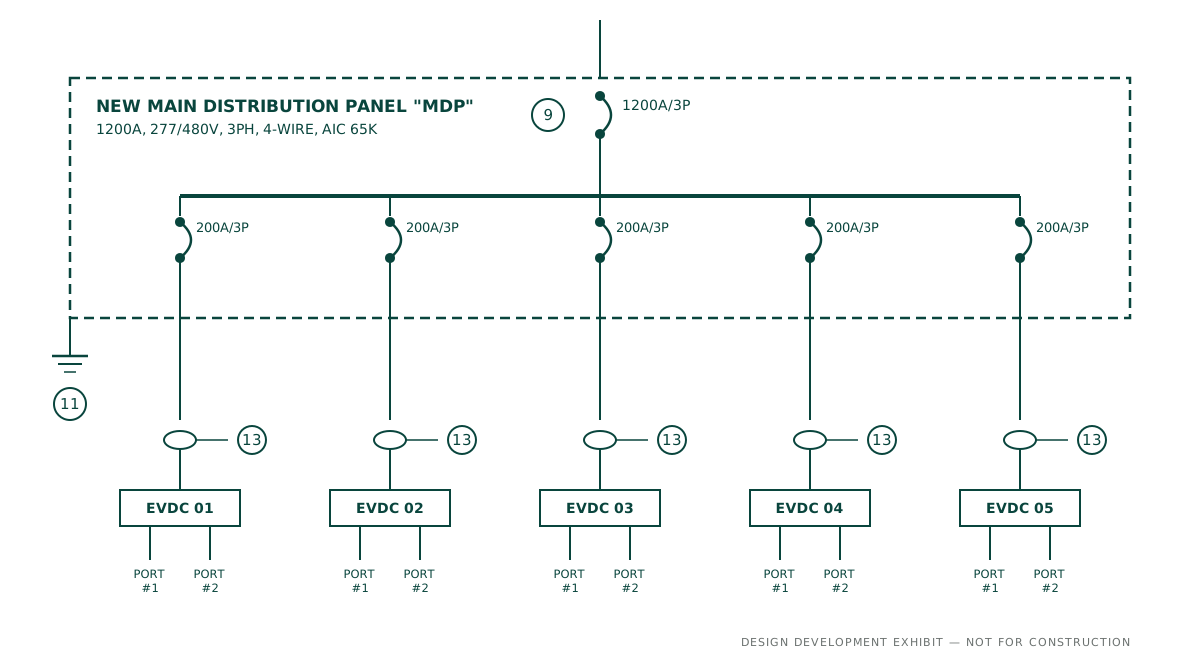
The project also produced a design-development one-line diagram — an intermediate step in the engineering process, before the assessment redirected the project — showing a new 1200A, 277/480V main distribution panel with five 200A/3P feeders sized for dual-port DC fast charging equipment. That drawing is a useful record of how much distribution capacity, panel space, and utility coordination DC fast charging would have required for a workplace duty cycle that Level 2 was always better suited to serve.
Why it matters for your project
Buying chargers before answering the engineering questions is one of the most common — and most expensive — mistakes in this industry. Equipment gets specified off a spec sheet or a sales conversation, not a load calculation or an honest look at how vehicles actually use the site. The KCMO Health Department project is what the fix looks like: a site assessment that asks what the duty cycle actually needs, a PE willing to say DC fast charging is the wrong tool for a long-dwell workplace duty cycle, and sealed engineering a contractor can actually build from. If your organization already owns chargers — or is about to buy them — this is the conversation to have first.