Turnkey Project Delivery
One partner, one contract — from first sketch to ribbon cutting.
EVre delivers complete charging projects: site assessment → engineering & design → permitting → equipment procurement → construction → commissioning → monitoring.
What’s included
- OEM-agnostic equipment selection — relationships across Tritium, Autel, Blink, Noodoe, and more mean the hardware fits your site, not a sales quota
- Licensed electrical contractors under EVre construction management
- Utility coordination (Evergy, Ameren) including new service and interconnection
- Startup, network configuration, and driver-ready commissioning
The sequence, step by step
Turnkey delivery runs through the same stages on every project, at different scale and duration.
- Assessment. What the site actually has — existing service, panel headroom, parking geometry, applicable utility rate. See Site Assessment & Feasibility Studies.
- Engineering. Load analysis, single-line development, PE-stamped issue-for-permit drawings, sealed by a Missouri-licensed engineer of record on every project. See Engineering & Design.
- Permitting. AHJ coordination and submittal, run alongside utility work wherever the jurisdiction allows it.
- Utility application timing. In Evergy territory we file through the Meter & Service Request portal under the “EV Charging Station” request type, which asks for existing and proposed demand in kW; Evergy publishes no standard turnaround. Ameren publishes a new-service process of roughly 19–83 business days (about 4–17 weeks), excluding utility construction and material procurement.
- Procurement and transformer lead time. Distribution transformer availability is the binding constraint industry-wide — lead times as long as two years have been reported, and a 429% increase in average lead times since 2020 has been reported by APPA members. We place long-lead orders as soon as a site is committed, not after permitting closes.
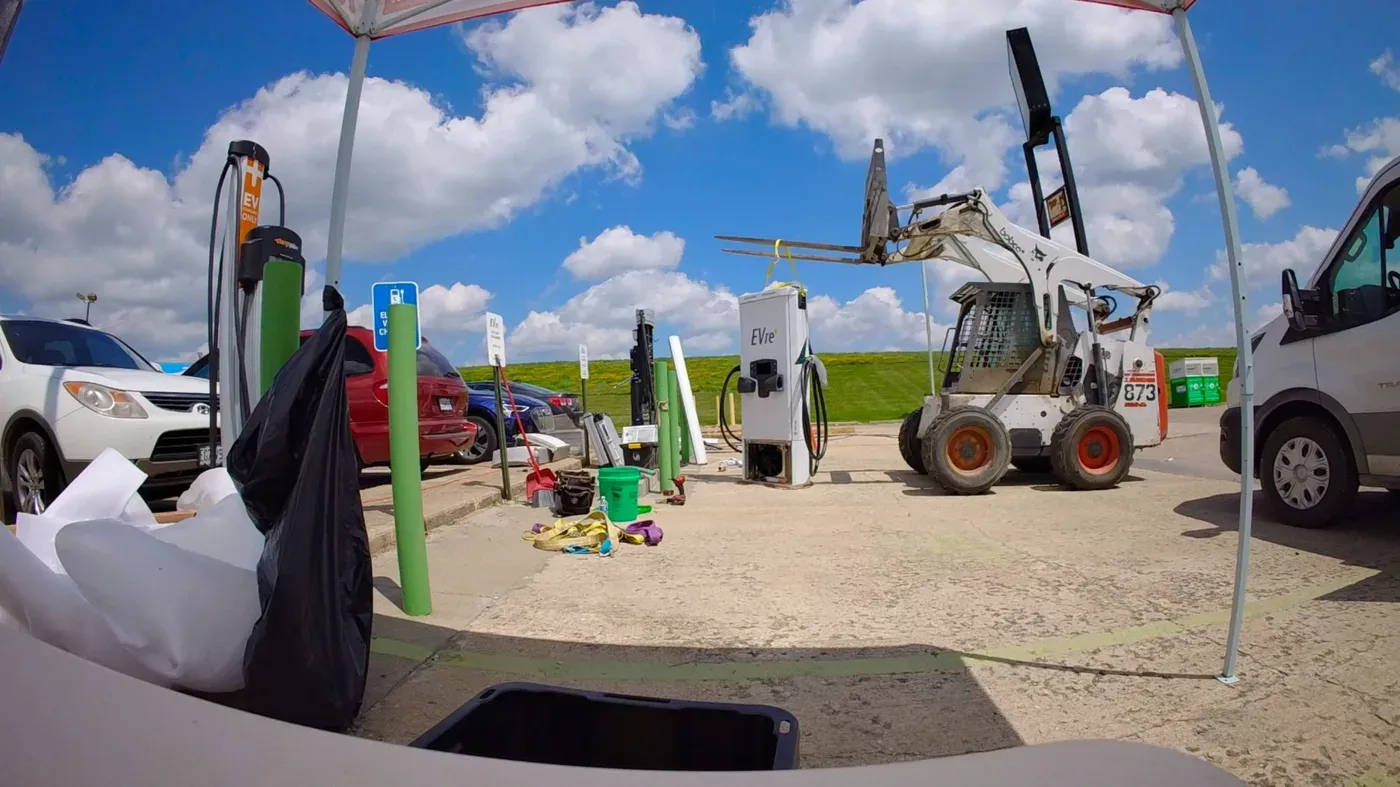
- Construction under EVre construction management. Licensed electrical contractors do the physical work; EVre manages schedule, inspections, and utility coordination points in between.
- Commissioning, staged to avoid a demand-charge event. A full-power acceptance test is itself a demand event — on some rate structures it can set the facilities-charge floor for the next 11–12 months. We stage testing port by port, or hold test power below the intended peak, so the test doesn’t become the bill.
- Network configuration, driver-ready go-live, and monitoring. Chargers are configured on OCPP 1.6J or 2.0.1 and, where supported, ISO 15118 Plug & Charge, then handed over driver-ready. Our own network gives us direct load-management experience before we ever touch a client’s site — and after go-live, we monitor.
Level 2 runs mostly on permitting timelines; DC fast charging runs mostly on utility and transformer timelines — which is why the two follow very different schedules.
Hardware we specify
We’re OEM-agnostic by design — equipment gets chosen to fit the site, not to hit a sales quota. That means Tritium for most DC fast charging installations, Autel as our Level 2 partner, and Blink or Noodoe for the network layer, depending on what the site owner needs from reporting, payment, and access control.
Tritium’s RTM75 is our primary DC fast charging unit: liquid-cooled, IP65-rated, rated -35°C to +50°C, splitting 75 kW across two vehicles on its twin cables at once, with ISO 15118 Plug & Charge support. We don’t just spec this hardware — we commission and operate it. Several of our own stations run 75 kW Tritium RTM75 units on Noodoe, and our Des Peres site runs 60 kW Blink DC fast chargers on Blink — 14 public ports total that we own, monitor, and troubleshoot ourselves.
Delivered where it’s hardest
At Olympic Oaks Village in Des Peres, EVre delivered two DC fast chargers inside an active retail shopping center — construction sequenced around business hours and access, with no impact to ongoing operations and a modern amenity added for the center’s tenants and visitors.
Recent scale
Our team has executed charging infrastructure projects with total installed cost (TIC) ranging from $20,000 up to $200,000 — the same disciplined sequence at every size, with a licensed PE behind every project.
Owner options
Turnkey delivery works under either ownership model:
- You own it, we build it. You fund the project; EVre carries it from assessment through commissioning and hands you a finished site.
- We design. We build. We operate (DBO). EVre funds and owns the equipment and pays the site host a revenue share — the structure behind our UMKC campus charging program.
See Partner With Us for how each model is structured.
What turnkey does not mean
Turnkey doesn’t mean a black box. You see the same engineering, procurement, and construction decisions we’re making — not a lump-sum number with the reasoning stripped out — and a licensed PE stands behind the design regardless of ownership model.
It doesn’t mean one hardware brand whether or not it fits your site; we stay OEM-agnostic because the right charger for a fleet depot isn’t usually the right charger for a public highway stop.
It doesn’t mean EVre disappears at ribbon-cutting — commissioning includes staged acceptance testing and a driver-ready handoff, and on projects EVre owns and operates, we stay on as the monitoring partner.
And it doesn’t mean utility costs get buried in a fixed number. Contribution-in-aid-of-construction charges, transformer costs, and rate-schedule selection are real, site-specific line items — we surface them during assessment, not as a surprise once construction starts.